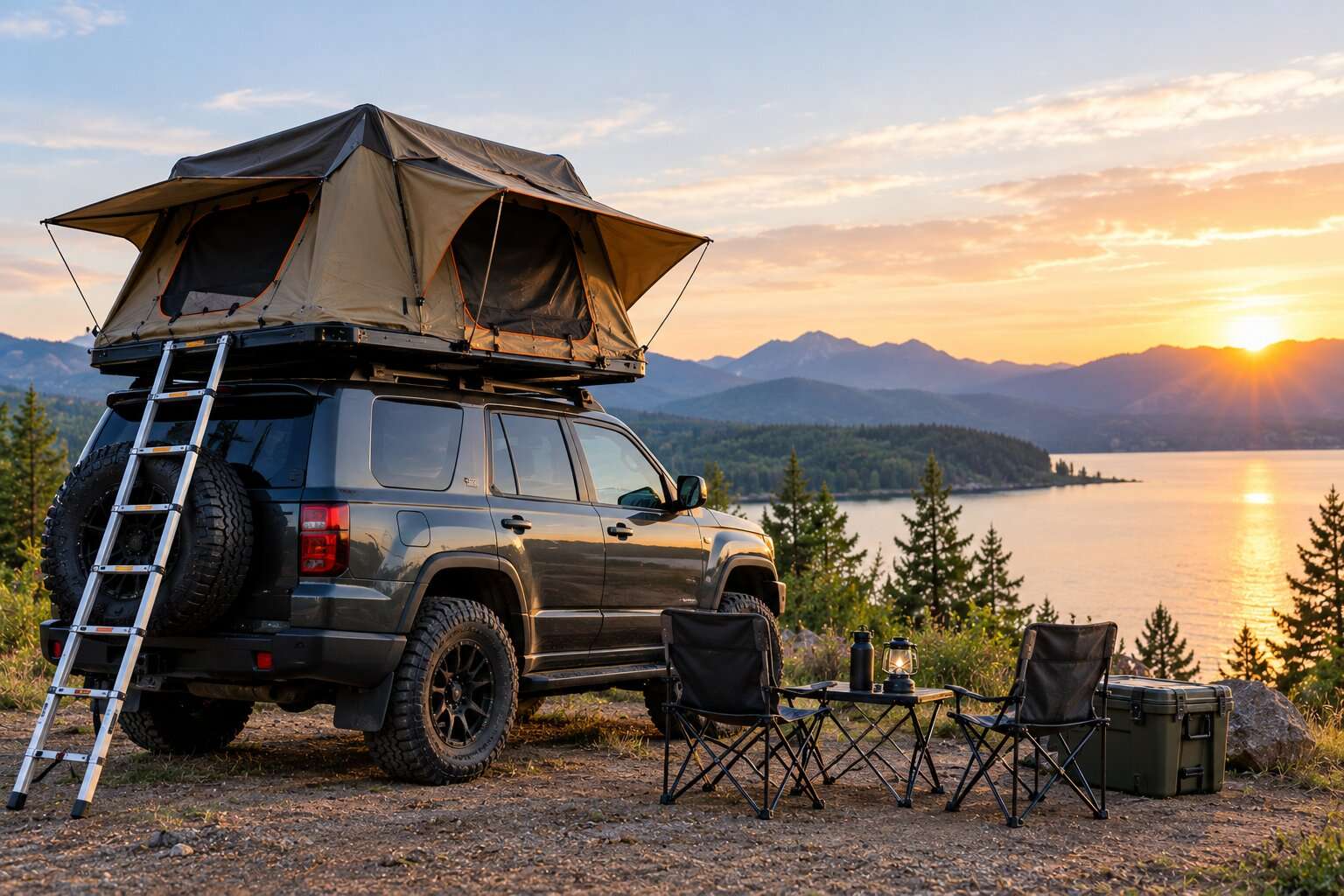
How to Choose a Rooftop Tent
Choosing the right rooftop tent starts with your vehicle, not the tent's appearance or advertised features. Before comparing designs, check your vehicle's roof load limit, roof rack compatibility, mounting requirements and available space. Then consider sleeping capacity, setup time, materials, weather protection and total ownership cost. This guide explains how to choose a rooftop tent that suits your vehicle, camping habits and budget, whether you are planning weekend trips, extended road travel or off-road adventures.
1. Start With Vehicle Compatibility and Roof Load Limits
Your vehicle determines which rooftop tents you can safely install. A tent that fits physically may still exceed your roof system's rated capacity or conflict with the vehicle's installation requirements.
Check the dynamic roof load limit
Dynamic roof load is the permitted load on the vehicle roof while driving. Check the vehicle owner's manual or manufacturer documentation for the applicable limit.
Your roof rack or crossbars also have their own load ratings. You must verify that the vehicle, rack, mounting hardware and tent are compatible as a complete system.
For an initial weight check, use:
Available tent weight allowance = vehicle's permitted dynamic roof load − the weight of components counted against that limit.
For example, if a vehicle permits a 75 kg dynamic roof load and its compatible roof rack weighs 10 kg, the preliminary allowance for the tent and other roof-mounted equipment is 65 kg. If the tent weighs 60 kg, only 5 kg remains for any additional equipment counted within that limit.
This is an illustrative calculation, not approval for a particular vehicle. Follow the vehicle and rack manufacturers' definitions of roof load, including any restrictions on accessories, mounting positions or load distribution. Never exceed the lowest applicable rated limit.
Understand static load separately
Static load concerns the vehicle and roof system when parked. The tent, occupants and any equipment must be supported within the applicable manufacturer specifications.
Do not estimate a safe static capacity by multiplying the dynamic roof rating by an arbitrary factor. The vehicle roof, rack, tent mounting points and supporting structure have different design requirements.
If the vehicle or tent documentation does not establish compatibility for the intended use, ask the manufacturers or a qualified installer before proceeding.
Measure the roof and mounting points
Check these dimensions before buying:
-
Crossbar spread: The distance between the bars must fall within the tent's permitted mounting range.
-
Roof width and length: Confirm that the mounting rails fit and that the tent does not interfere with the vehicle.
-
Closed height: Consider garage clearance, car parks, overhead branches and low structures.
-
Open dimensions: Check whether the deployed tent extends beyond the vehicle's sides or rear.
-
Tailgate clearance: Make sure the tent and ladder will not obstruct an opening tailgate or rear door.
-
Rack configuration: Confirm that the rack is designed to carry a rooftop tent, rather than assuming ordinary cargo bars are suitable.
A small SUV and a full-size pickup may have very different mounting options. Neither vehicle type automatically guarantees compatibility.
2. Choose the Right Rooftop Tent Type
Rooftop tents generally fall into hard-shell and soft-shell designs. Neither is universally better. Your choice should reflect how often you move campsites, how much space you need and how much setup work you are willing to do.
Hard-shell rooftop tents
Hard-shell tents use a rigid outer shell, commonly made from materials such as ABS plastic, fibreglass or aluminium. Many models use gas struts or another assisted opening mechanism.
Advantages:
-
Usually quick to open and close.
-
Rigid shells protect the folded tent fabric during travel.
-
Some models allow bedding to remain inside when closed.
-
Many have a compact, streamlined closed shape.
Limitations:
-
The rigid shell and supporting hardware can add weight.
-
The internal sleeping area may be constrained by the shell dimensions.
-
Purchase prices can be higher.
-
Some designs extend beyond the vehicle when opened, so the footprint must be checked.
Hard-shell tents can suit road-trippers who change locations frequently and want to reduce setup time at each stop.
Soft-shell rooftop tents
Soft-shell tents use a foldable fabric body, often supported by a frame and deployed over a hinged or folding base.
Advantages:
-
Many models provide a generous sleeping area when opened.
-
Some offer larger annexes or additional covered space.
-
They may provide more flexibility in sleeping layouts and accessories.
-
A folded design can suit buyers prioritizing sleeping space over the most compact setup.
Limitations:
-
Setup and packing can take longer.
-
Fabric requires drying and regular inspection.
-
A protective travel cover may need to be secured before driving.
-
Some models have a larger open footprint and more exposed fabric.
Soft-shell designs can be attractive for longer stays at one campsite, especially when additional covered space is useful.
Hard shell vs. soft shell: which should you choose?
| Factor |
Hard shell |
Soft shell |
| Setup |
Often faster |
Often requires more steps |
| Sleeping area |
Depends on shell design |
Often expands considerably when opened |
| Closed profile |
Frequently compact |
May require a larger folded package |
| Weather exposure |
Rigid shell protects folded fabric |
Folded fabric needs suitable protection |
| Storage |
Depends on shell size and mounting system |
Depends on folded dimensions and accessories |
| Best fit |
Frequent stops and quick overnight stays |
Buyers prioritizing open space and flexible layouts |
These are general tendencies, not guarantees. Compare the actual specifications of individual models. Tent type alone does not determine weight, durability, weather resistance or comfort.
3. Compare Materials and Construction Quality
The shell, tent fabric, base, frame and mounting hardware each affect performance. Evaluate them separately instead of relying on a single material label.
Shell materials
ABS plastic: ABS can be used for rigid shells with relatively low weight. Ask about shell construction, UV resistance, impact performance, repair options and warranty coverage.
Fibreglass: Fibreglass shells can provide a rigid enclosure, but construction quality, reinforcement and finish vary by model. Inspect the edges, joints and mounting areas rather than judging the material by name alone.
Aluminium: Aluminium shells can provide a rigid structure, but their overall weight and performance depend on thickness, design and supporting components. Check for corrosion protection, joint quality and hardware compatibility.
No material is automatically the best choice in every situation. A well-designed product with suitable construction and documented support can be a better purchase than a poorly built alternative using a premium-sounding material.
Tent fabrics
Polyester, poly-cotton and canvas offer different combinations of weight, breathability, drying time and durability.
-
Polyester: Often dries relatively quickly and can be lightweight. Performance depends on the weave, coating and fabric construction.
-
Poly-cotton: Combines synthetic and cotton fibres, balancing several fabric properties. It may require more drying time than lightweight synthetic fabric.
-
Canvas: Can offer a substantial fabric structure, but its weight, treatment and care requirements vary.
Ask the seller for the fabric specification, waterproof rating, UV protection details, seam treatment and care instructions. If the manufacturer requires seasoning or another initial treatment, follow its instructions before the first trip.
Inspect the base and mounting hardware
The floor, hinges, rails, brackets, bolts and support structure carry important loads. Look for clear specifications and installation documentation.
Ask whether the mounting hardware is included, whether replacement parts are available and whether the product has been designed for your roof rack configuration. For frequent off-road use, also ask about inspection intervals and the manufacturer's guidance for vibration and rough terrain.
4. Choose the Right Sleeping Capacity and Dimensions
A tent's advertised capacity tells you how many occupants the manufacturer intends it to accommodate. It does not guarantee comfortable sleeping space for every group.
Measure the usable sleeping area
Check the internal sleeping width and length rather than relying on the outside shell dimensions.
A simple planning calculation is:
Approximate width per person = usable internal sleeping width ÷ number of occupants.
For example, a sleeping area 197 cm wide shared by four people gives approximately 49 cm of width per person. That may be restrictive for four adults, even if the product is marketed for that number of occupants.
Consider body size, sleeping position, bedding, children and pets before deciding. If possible, compare the dimensions with a bed or sleeping mat you already use.
Check mattress thickness and support
A thicker mattress does not automatically provide better insulation or comfort. Material density, construction, body support and the temperature range all matter.
Before buying, check:
-
Mattress dimensions and thickness.
-
Whether the mattress can remain inside when the tent is closed.
-
Ventilation beneath the mattress.
-
Whether an anti-condensation mat is recommended.
-
Availability of replacement mattresses or compatible accessories.
For couples, families or longer trips, a slightly larger sleeping area may be worth the additional weight and cost. However, return to the roof load calculation before choosing a larger model.
5. Evaluate Weather Resistance and Seasonal Suitability
A rooftop tent must cope with more than light rain. Wind, humidity, temperature changes, condensation and prolonged exposure can all affect comfort and performance.
Understand waterproof ratings
Fabric waterproof ratings are often expressed as hydrostatic head in millimetres. The test measures how much water pressure a fabric sample can withstand before water passes through it under the specified test conditions.
A higher rating can indicate greater resistance to water pressure, but it does not prove that the complete tent will remain dry in every storm.
Water can enter through poorly sealed seams, zippers, corners, vents or damaged coatings. Assembly, wind direction, maintenance and exposure also matter.
When comparing models, ask for:
-
The fabric's stated waterproof rating and test information.
-
Details of seam taping or sealing.
-
Zipper and opening protection.
-
Manufacturer guidance for heavy rain and wind.
-
Care instructions for maintaining the fabric coating.
Do not rely on a single waterproof number as a guarantee of complete weather protection.
Plan for condensation
Condensation occurs when moist air contacts a surface cold enough for water vapour to condense. Breathing adds moisture to the tent, while cold surfaces, humidity and limited ventilation can make the problem worse.
Choose a design with practical ventilation options. Check whether windows can remain open safely in suitable weather, whether air can circulate beneath the mattress and whether the manufacturer recommends an insulated base or anti-condensation mat.
Ventilation helps manage moisture, but it does not eliminate condensation in every condition. Dry the tent thoroughly after use and follow the manufacturer's storage instructions.
Never use fuel-burning camping heaters inside an enclosed tent while sleeping. Carbon monoxide can accumulate to dangerous levels without obvious warning.
Consider the climate where you camp
| Camping conditions |
What to prioritize |
| Hot weather |
Cross-ventilation, mesh openings and suitable shade |
| Frequent rain |
Sealed seams, protected openings and clear rain-use guidance |
| Cold weather |
Insulation options, condensation management and documented temperature suitability |
| Windy locations |
Manufacturer wind limits, secure mounting and correct setup |
| Humid environments |
Ventilation, drying time and mould prevention |
A four-season label is not a universal guarantee of suitability for extreme weather. Check the manufacturer's operating guidance for the conditions you expect to encounter. Pack down when required by the manual, particularly before severe weather exceeds the tent's stated limits.
6. Check Installation and Daily Usability
A tent that is difficult to access or awkward to deploy can become frustrating on a long trip.
Review the installation process
Before installation, confirm that the roof rack is approved for the application and that all mounting components are suitable for the vehicle and tent. Follow the prescribed bolt positions, tightening specifications and inspection procedure.
Do not improvise brackets or drill into a vehicle roof without appropriate manufacturer approval and qualified guidance.
After installation, check the complete assembly according to the manuals. Inspect mounting hardware at the prescribed intervals, particularly after rough-road travel.
Think about access and the ladder
Measure the distance from the ground to the tent entrance. Check whether the ladder reaches the required height and can be positioned securely on the ground.
A tall vehicle may require a different ladder arrangement from a low crossover. Consider whether you can climb comfortably, carry bedding or supplies up safely and manage the ladder in wet conditions.
Also think about the everyday burden. Climbing a ladder every night may be inconvenient for young children, people with mobility limitations or campers travelling with large pets.
Check opening direction
Side-opening and rear-opening designs can affect how the tent interacts with the vehicle. A rear-opening model may obstruct a tailgate, depending on the vehicle geometry and the tent's deployed dimensions.
Check the fully open arrangement before purchasing. A tent that looks compact in a product photograph may occupy considerably more space at the campsite.
7. Calculate the Total Cost of Ownership
The advertised tent price is only one part of the budget. Compatible roof bars, installation, accessories, delivery and ongoing maintenance can change the final cost significantly.
Include these items in your budget:
-
Rooftop tent and required mounting hardware.
-
Compatible roof rack or crossbars.
-
Professional installation, if needed.
-
Annexes, insulation liners or anti-condensation accessories.
-
Locks and security equipment.
-
Storage equipment or a suitable hoist.
-
Freight delivery and any difficult return arrangements.
-
Replacement parts, fabric care and periodic maintenance.
Prices vary by market, model, size and specification. Compare quotations using the same currency and date, and confirm whether taxes, delivery and accessories are included.
Before ordering, check the warranty period, exclusions, spare-parts availability and the process for obtaining support if a component fails. A lower initial price may not represent better long-term value if essential parts are difficult to source.
Should you buy a used rooftop tent?
A used model may reduce the purchase cost, but inspect it carefully before committing.
Check the shell for cracks, the fabric for mould or damage, the seams and zippers for deterioration, and the hinges, struts, rails and mounting points for wear or corrosion. Ask about previous repairs, storage conditions, age and warranty transferability.
Request the original manual and verify that the mounting hardware is complete. If the seller cannot demonstrate the tent opening, closing and locking correctly, factor the uncertainty into your decision.
8. Plan Storage, Delivery and Maintenance
Rooftop tents can be bulky and heavy to handle. Before buying, decide whether you will leave the tent installed between trips or remove it after use.
Leaving it installed reduces repeated lifting, but adds permanent roof weight, increases vehicle height and may affect fuel consumption. Removing it reduces the travelling load when you do not need it, but requires safe handling and somewhere suitable to store it.
If you use a hoist, confirm that its rated capacity exceeds the complete load being lifted and that the lifting arrangement follows the equipment manufacturer's instructions. Never work beneath an inadequately supported tent.
For storage, follow the tent manufacturer's guidance. Dry the fabric and mattress before long-term storage, inspect for damage and keep the tent in a clean, suitable environment. Storing damp fabric can encourage mould and unpleasant odours.
Also confirm whether your intended campsites permit rooftop tents. Rules may vary by campsite, vehicle type and local regulations.
9. Use This Rooftop Tent Buying Checklist
Before placing an order, verify each of the following:
| What to check |
What to confirm |
| Vehicle roof limit |
Published dynamic roof load and applicable restrictions |
| Roof rack |
Rated capacity and compatibility with the vehicle and tent |
| Tent weight |
Complete travelling weight, including components counted toward the limit |
| Static support |
Manufacturer guidance for parked use and occupant loading |
| Mounting |
Bar spread, rail spacing, brackets and hardware |
| Dimensions |
Closed height, open footprint, sleeping width and length |
| Capacity |
Realistic room for the intended occupants |
| Materials |
Shell construction, fabric, hardware and care requirements |
| Weather resistance |
Waterproof specification, seam protection and operating limits |
| Installation |
Correct procedure, tools and inspection requirements |
| Ownership costs |
Rack, accessories, delivery, storage and maintenance |
| After-sales support |
Warranty, replacement parts and technical assistance |
If any critical compatibility or loading specification is missing, obtain clarification before buying rather than assuming the tent will fit.
10. When a Rooftop Tent May Not Be the Best Choice
A rooftop tent is not ideal for every camper.
Consider a ground tent if you want to leave your campsite set up while using your vehicle for day trips. A ground tent may also be easier if you dislike climbing a ladder or need convenient access for children and pets.
A trailer tent or another camping setup may be more suitable if you need a large living area or prefer not to carry a tent on the vehicle roof.
Rooftop tents work best when their advantages match your travel habits. Frequent overnight stops, limited campsite space and a desire to keep sleeping equipment elevated may justify the additional expense and installation requirements.
Frequently Asked Questions
1. How do I choose a rooftop tent for the first time?
Start with vehicle compatibility, roof load limits and mounting requirements. Then compare hard-shell and soft-shell designs, sleeping dimensions, ventilation, weather protection and total cost. Prioritize the features you will use regularly instead of paying for accessories that do not suit your camping style.
2. Can any car support a rooftop tent?
No. A car must have a suitable roof load rating and a compatible roof rack or mounting system. Check the vehicle and rack manufacturers' instructions before purchasing. Do not assume that an SUV can support a tent simply because it has a larger body.
3. Are hard-shell rooftop tents better than soft-shell tents?
Neither type is universally better. Hard-shell tents often open and close quickly, while soft-shell designs can offer a larger deployed sleeping area. Compare individual models for weight, dimensions, weather resistance, setup requirements and price.
4. How many people can sleep in a rooftop tent?
Capacity depends on the usable internal dimensions and the occupants' sizes. Divide the sleeping width by the number of people to understand the approximate space available per person, then consider sleeping length, bedding and comfort. Advertised capacity does not guarantee generous room for every occupant.
5. Can you leave a rooftop tent on your car all year?
Some owners leave tents installed between trips, but suitability depends on the vehicle, rack, tent instructions, local weather and storage conditions. Check the permitted travelling load, inspect mounting hardware and follow guidance about prolonged exposure, cleaning and removal during severe weather.
6. Are rooftop tents waterproof?
Water resistance varies by fabric, coatings, seams, zippers and construction. A waterproof rating helps compare fabric performance, but cannot guarantee that the complete tent will remain dry in every condition. Follow the manufacturer's weather limits and inspect seals and fabric regularly.
7. Can you use a rooftop tent in winter?
Some models are designed for colder conditions, but performance depends on insulation, ventilation, condensation control and the manufacturer's stated operating limits. Check the tent's suitability for expected temperatures, snow and wind. Never use fuel-burning heaters inside an enclosed tent while sleeping.
8. What is the total cost of a rooftop tent?
The total depends on the tent, compatible roof rack, installation, accessories, delivery and maintenance. Obtain a complete quotation rather than comparing tent prices alone. Confirm warranty coverage and spare-parts availability before making a purchase.
Conclusion
The best rooftop tent is one that fits your vehicle, stays within the applicable load limits and suits the way you camp. Start with compatibility and mounting requirements, then compare usable sleeping space, materials, ventilation, weather resistance and total ownership costs.
For frequent road-trippers, setup speed may be a priority. For families or longer campsite stays, sleeping space and access may matter more. Taking time to check the specifications before buying can help you avoid expensive fitment problems and choose a rooftop tent that remains practical over years of use.
If you are comparing hard-shell options for an SUV or pickup, explore YHTD Coachworks' rooftop tent range and review the specifications of individual models against your vehicle and rack requirements before requesting a quotation.